


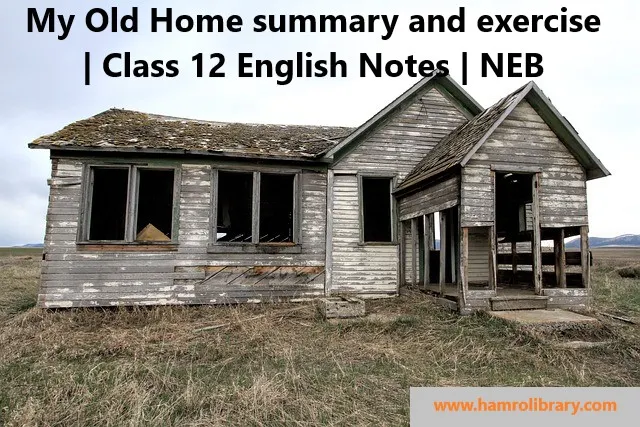
My Old Home summary and exercise | Class 12 English Notes | NEB

My Old Home by Lu Xun
Summary for Class 12 NEB Students
Lu Xun (1881–1936), born Zhou Shuren, was a pioneering Chinese writer and thinker, widely regarded as the father of modern Chinese literature. Coming from a Confucian family with a scholarly background, Lu Xun became famous for his short stories, essays, and translations that critiqued early 20th-century Chinese society. His works, including A Madman’s Diary, Hometown, and Medicine, are celebrated for their insight into human nature, social structures, and moral values. My Old Home, from the collection Hometown, is a reflective story that explores nostalgia, memory, and the contrast between past expectations and present reality.
My Old Home narrates Lu Xun’s journey back to his childhood home after many years, highlighting the tension between memory and reality. The protagonist, Lu Xun himself, recalls his youthful experiences in his family house, the playful interactions with his boyhood friend Runtu, and the guidance of his loyal servant Jun Tu. Upon returning, he discovers that much has changed: the house is less vibrant, some neighbors have moved away, and life’s hardships have altered the people he once knew. Lu Xun reconnects with his mother, nephew Hung Erh, and Runtu, observing the effects of poverty, societal pressures, and superstitions on their lives. He experiences a mixture of happiness, sorrow, and nostalgia, realizing that the idealized memories of his youth cannot fully match the reality he finds.
The story’s themes revolve around nostalgia, memory versus reality, friendship, loyalty, filial piety, and social inequality. Lu Xun portrays the struggle of reconciling idealized childhood recollections with the limitations and hardships of adult life. The bond between Lu Xun and Jun Tu exemplifies Confucian ideals of friendship and loyalty, while the story also emphasizes respect for social roles and responsibilities. Ultimately, Lu Xun leaves his old home with a sense of reflection, understanding that moving forward in life requires leaving the past behind while cherishing its lessons.
Main Characters
-
Lu Xun: The protagonist and narrator, reflecting on his childhood and adulthood.
-
Jun Tu: The spirited but cautious former servant, loyal to Lu Xun.
-
Mrs. Yang: The chatty and humorous neighbor who ran a beancurd shop.
-
Hung Erh: Lu Xun’s timid nephew.
-
Shu Sheng: Jun Tu’s fifth son, representing continuity of the next generation.
Glossary
-
li (n.): traditional Chinese unit of distance, about 1,640 feet
-
rationalize (v.): to explain or justify something logically
-
sacrificial vessels (n.): ancient cooking or storage cauldrons with ceremonial uses
-
intercalary (n.): a day or month added to align the calendar, like February 29
-
talisman (n.): an object believed to bring luck or have magical powers
-
hedgehog (n.): a small spiny mammal that can roll into a ball for protection
-
concubine (n.): a woman living with a man but with lower status than his wife
-
treadmill (adj.): monotonous, tiring, or unrewarding
-
stupefied (adj.): shocked or amazed
-
flabbergasted (adj.): extremely surprised or astonished
Before Reading
a. How do you feel if you visit a place after an interval of ten years?
Ans. Visiting a place after ten years often creates a mix of nostalgia, curiosity, and surprise. The place may feel unfamiliar, almost as if it is new, even though it is deeply connected to our past. Changes in landscape, buildings, or surroundings can make old memories feel distant, while some familiar landmarks may trigger vivid recollections of childhood experiences. This contrast between memory and reality often produces a strong emotional response.
b. Who is your best childhood friend? What special memories do you share with him/her?
Ans. My best childhood friend is Santosh. We share many memorable experiences, including one particular accident while trying to swim together. That incident, though frightening at the time, has become a humorous and unforgettable memory. Such moments of shared adventure, laughter, and even mischief often strengthen the bond between childhood friends and leave a lasting impact on our emotional development.
Understanding the Text
a. How does the narrator describe his feeling at the arrival of his old home?
Ans. Upon returning to his hometown, the narrator experiences a deep sense of melancholy and disappointment. The place he remembered from childhood no longer exists as he imagined, and the surroundings do not show the signs of progress he had expected. This feeling of helpless depression is compounded by his own pre-existing mood, which was not cheerful when he arrived. Yet, beneath this initial gloom, there is also a subtle recognition that the place itself may not be as disheartening as it seems; the narrator’s feelings are shaped by personal nostalgia and expectation, rather than objective reality.
b. What were the three kinds of servants in China then? What does it indicate about contemporary Chinese society?
Ans. The three kinds of servants in China were:
-
Full-timers: Worked all year for a single family.
-
Dailies: Hired on a day-to-day basis.
-
Part-timers (busy-monthers): Farmed their own land and only worked for families during special occasions, festivals, or rent collection.
This division reflects the social and economic inequality of contemporary Chinese society. While some laborers were tied to wealthy households year-round, others were exploited intermittently, indicating a rigid class system where wealth and privilege shaped access to work, security, and social mobility.
c. What makes the narrator nostalgic? What did he do with Runtu in their teenage?
Ans. The narrator feels nostalgic because of Runtu’s respectful and formal behavior during their childhood. Runtu addressed him as “Master,” contrasting with the casual “Brother Xun” used among peers. Their teenage experiences—hunting Zha, catching birds, and collecting shells—evoke vivid memories of carefree youth and companionship. These shared activities highlight a simpler time and a close friendship, making the narrator long for the innocence and excitement of his formative years.
d. How did Runtu hunt a Zha in his young age?
Ans. As a child, Runtu hunted Zha by thrusting a pitchfork at the animal. However, the Zha was cunning and quick, often evading capture with sudden, lightning-fast movements that allowed it to escape between his legs. This demonstrates Runtu’s skill, patience, and resilience, as well as the natural challenges he faced in rural life.
e. How does the narrator make a humorous picture of Mrs. Yang?
Ans. The narrator humorously describes Mrs. Yang standing with her hands on her hips, legs apart, wearing trousers, and balancing awkwardly on her small feet. He likens her posture to a compass from a drafting kit, creating a vivid, playful image that exaggerates her stance for comic effect. This description reflects the narrator’s keen observation and ability to find humor in ordinary situations.
f. According to the narrator, what were different factors that made Runtu a poor man throughout his life?
Ans. Runtu’s lifelong poverty resulted from multiple factors:
-
Natural challenges such as badgers, Zha, and hedgehogs destroying crops.
-
Socioeconomic pressures including children, famines, taxes, soldiers, bandits, and demands from officials and landlords.
-
Unpredictable harvests and fluctuating market prices.
Despite the family’s hard work, these factors ensured that Runtu never had enough to live comfortably. His struggles reflect the broader difficulties faced by rural laborers in a society with minimal protection against natural and social adversities.
g. How does the narrator help Runtu before leaving the old home?
Ans. Before leaving, the narrator generously helps Runtu by offering him all items they were not taking. He allows Runtu to choose freely, demonstrating compassion and a sense of responsibility toward those who had served his family faithfully. This act of kindness reflects a deeper moral lesson about sharing, respect, and gratitude.
h. How does the author differentiate two kinds of idols?
Ans. The author distinguishes between real idols and ideal idols. Real idols exist in tangible form, while ideal idols represent perfection or aspiration. The real often fails to meet the ideal, creating a metaphorical “distance” between expectation and reality, sometimes causing discomfort or disappointment. This distinction emphasizes the tension between ideals and practical realities, a theme that remains relevant in both personal and societal contexts.
Reference to the Context
a. While reading the friendship between the narrator and Runtu, Hindu readers remember the friendship between Krishna and Sudama. Which particular description reminds you of the mythological example?
Ans. In the story My Old Home, the narrator and Runtu were childhood friends who shared close companionship during their teenage years. Despite their equality in childhood, after thirty years, Runtu addresses the narrator as “Master,” reflecting the social gap that has emerged over time. This moment evokes nostalgia in the narrator, highlighting the changes that social and economic circumstances bring to relationships. Runtu, being poor, hesitates to be fully open, while the narrator, with his compassionate and open-hearted nature, attempts to understand Runtu’s situation and help him.
A similar dynamic exists in the mythological story of Krishna and Sudama. Krishna and Sudama were inseparable childhood friends who studied under the same guru. Later, Krishna became the king of Dwarika, while Sudama remained poor. When Sudama visited Krishna to seek help, he brought nothing valuable but Krishna, out of friendship and compassion, rewarded him generously.
In both stories, childhood friendship transcends social barriers and material differences. Both the narrator and Krishna act selflessly to support their friends, demonstrating that true friendship can overcome inequality and hardships, enriching the lives of both.
b. How does the story support the proposition that the relationships of childhood are innocent, impartial, and disinterested?
Ans. The friendship between Jun-Tu and Hsun (the narrator) was marked by simplicity, joy, and equality. They shared playful and adventurous activities, such as hunting birds, catching animals like badgers and hedgehogs, and collecting shells. Their friendship was free from material concerns or social hierarchies, reflecting innocence and mutual respect.
There were no notions of superiority or inferiority, and neither sought to take advantage of the other. The relationship was natural and selfless, characterized by care and trust. However, as they grew older, social and economic changes influenced their interactions. The story highlights that while childhood friendships are pure and impartial, external circumstances like social barriers can affect these relationships in adulthood.
c. After reading the story, what inferences can you make about contemporary Chinese economic and social system?
Ans. The story depicts clear social hierarchies and economic disparities in contemporary Chinese society. Servants, such as Jun-Tu, were tied to wealthier households, and their children recognized the social boundaries from a young age. Even after thirty years, these boundaries persisted; Jun-Tu addressed the narrator as “Master,” reflecting enduring class distinctions.
The story also illustrates the hardships faced by lower-class families: reliance on agriculture, vulnerability to famine and taxes, and limited opportunities for advancement. Economic insecurity, combined with social hierarchies, meant that wealth and privilege were concentrated among the upper classes, while ordinary families struggled for survival.
d. What does the story indicate about the geographical features of the narrator's hometown?
Ans. The narrator recalls activities such as guarding watermelons, collecting shells, and hunting animals, which suggest that his hometown was a tropical or temperate region suitable for watermelon cultivation. The presence of shells indicates proximity to the sea, while references to forests and hills suggest a rural landscape with natural resources. The village appears eco-friendly and green, without modern infrastructure, indicating a traditional and environmentally rich setting.
Reference Beyond the Text
a. Human beings are on the road from time immemorial, always migrating to new places. Write an essay on The Trend of Migration in Nepal (approx. 300 words)
Ans. Migration is the movement of people from one place to another, often in search of better opportunities or living conditions. Throughout history, humans have migrated for survival, resources, and exploration. In Nepal, migration has been a consistent trend due to geographical challenges, natural disasters, economic hardships, and the pursuit of better education and employment.
Labor migration is particularly significant in Nepal. Around three million Nepalese work abroad, sending remittances that support their families and contribute to the national economy. Internal migration is also common. People from mountainous and hilly regions move to the Terai, valleys, or urban centers seeking education, healthcare, and employment opportunities.
Migration is influenced by both push and pull factors. Pull factors include better employment, infrastructure, social opportunities, and improved living standards. Push factors include natural calamities, unemployment, poverty, social inequality, and limited access to resources.
To reduce migration caused by economic necessity, the government must improve rural infrastructure, create employment opportunities, and provide better healthcare and education. Enhancing local livelihoods would encourage people to remain in their native regions while improving overall social and economic stability. Migration is a natural phenomenon but can be guided to balance economic growth and social development.
b. Report on a relative or friend who migrated to a new place
Ans. I spoke with my uncle, who migrated to Kathmandu from Baglung with his family. My cousin Nabin and I were childhood classmates. When I asked my uncle about his feelings while leaving Baglung, he shared a mixture of nervousness and excitement.
He felt emotional about leaving his family, friends, and the familiar village environment. The shift to Kathmandu meant he had to take on responsibilities previously managed by elders in the village, facing an unknown society and new challenges. The family migrated mainly for Nabin’s education and future prospects.
Despite the anxiety, my uncle was also excited to experience city life, new cultures, and job opportunities. Migration required starting life from scratch, but he hoped for better opportunities and a brighter future. The experience reflects the emotional complexity of migration—leaving familiar surroundings and loved ones, yet striving for progress and growth.
 The Economic Frontline is a knowledge-driven platform offering thoughtful economic perspectives, policy-focused, and analytical content on national and global financial trends.
